
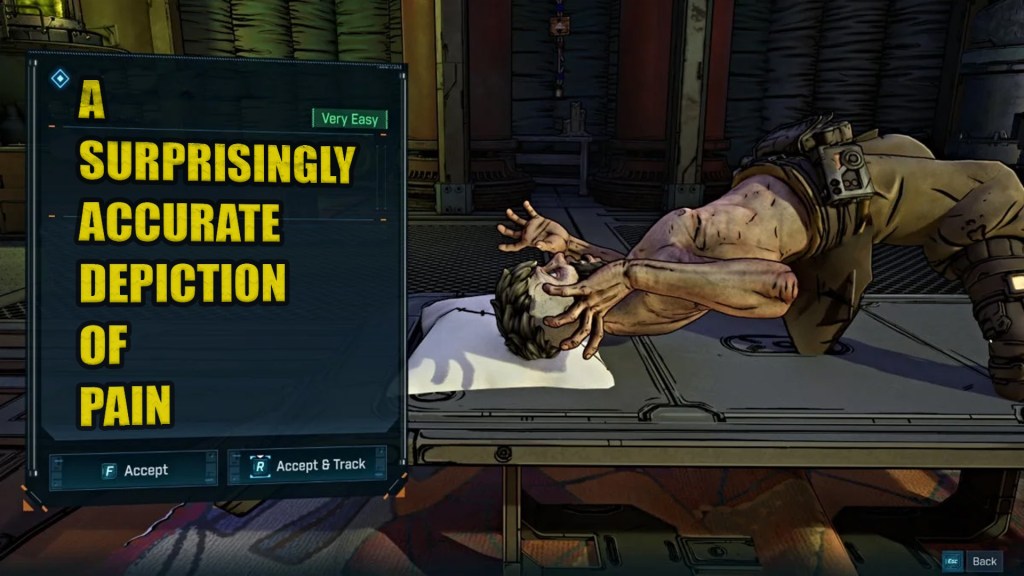
Unlike other narrative forms, video games allow players to explore deep, unsettling, and confrontational themes interactively, while maintaining the comfort that comes from viewing events through a screen. They let us live in someone else’s shoes without fully surrendering ourselves to their experiences – a crucial distinction when those experiences involve pain, trauma, or mental illness.
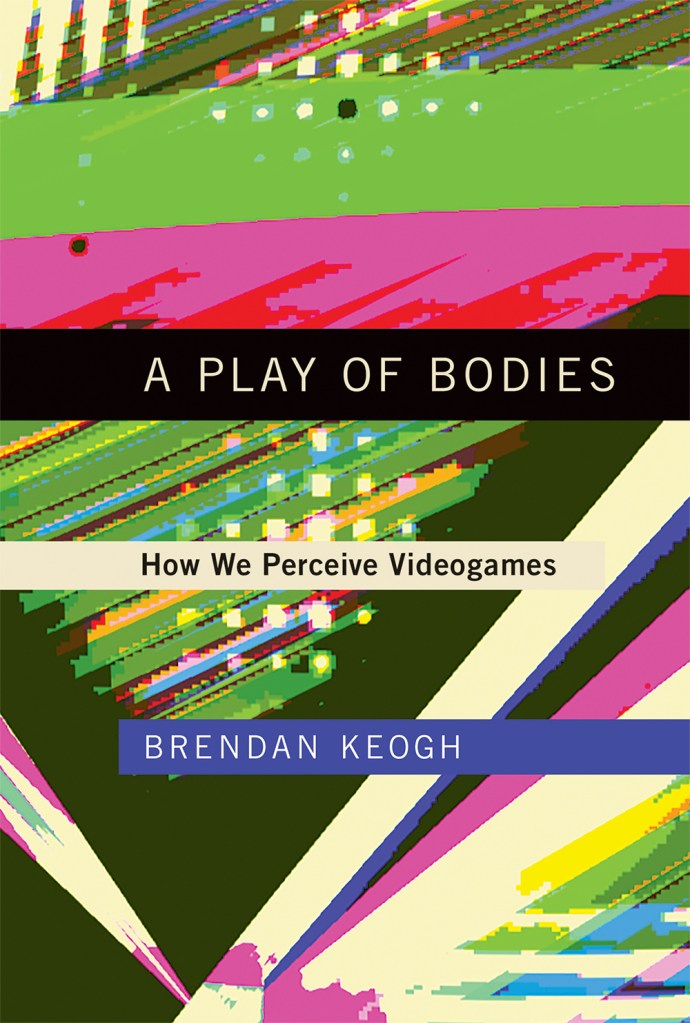
In his book, A Play of Bodies: How We Perceive Video Games, Brendan Keogh argues that games are uniquely positioned to model experience rather than simply describe it, allowing players to “feel systems, pressures, and limitations rather than simply observe them.” It’s this capability that makes games such a powerful mechanism for exploring suffering.
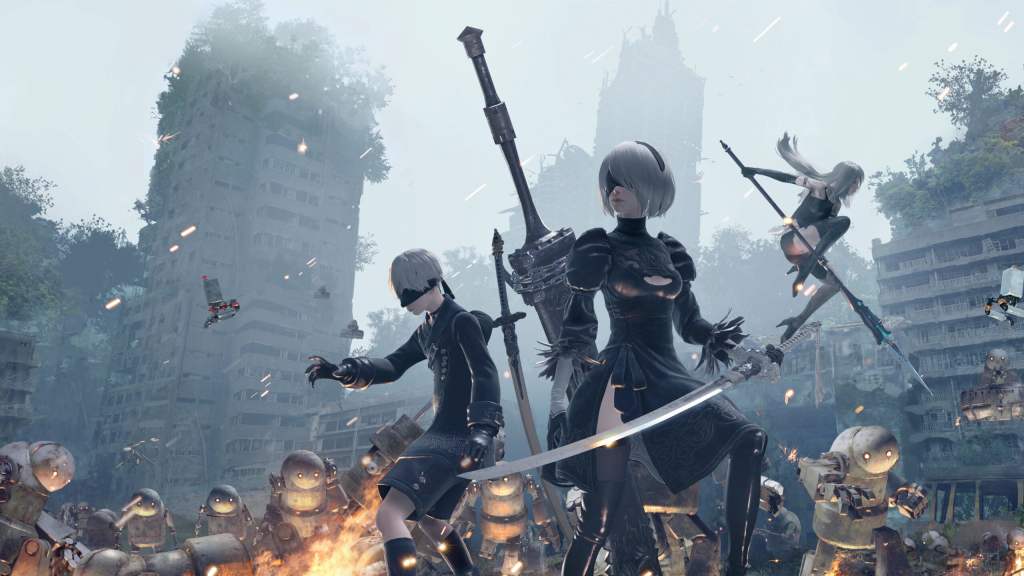
Some titles are universally recognised and praised for tackling complex issues. NieR: Automata explores the meaning of existence and the cycle of life and death, ultimately favouring absurdism over nihilism. SOMA examines the relationship between consciousness and identity, questioning whether identical copies of your mind can truly be considered “you”. Papers, Please forces players to balance strict rules against their own humanity and compassion in the role of an immigration officer.
Other examples may come to mind – games that resonated with you on a personal level. Games that translate abstract concepts into something playable and approachable. But one series that almost never enters this conversation is Borderlands.
The Borderlands games are hardly known for their earnestness. Their distinct brand of over-the-top humour makes it difficult for serious messages to land with emotional weight. Any attempt at sincerity is often undercut by the loot chase or poorly timed toilet humour.
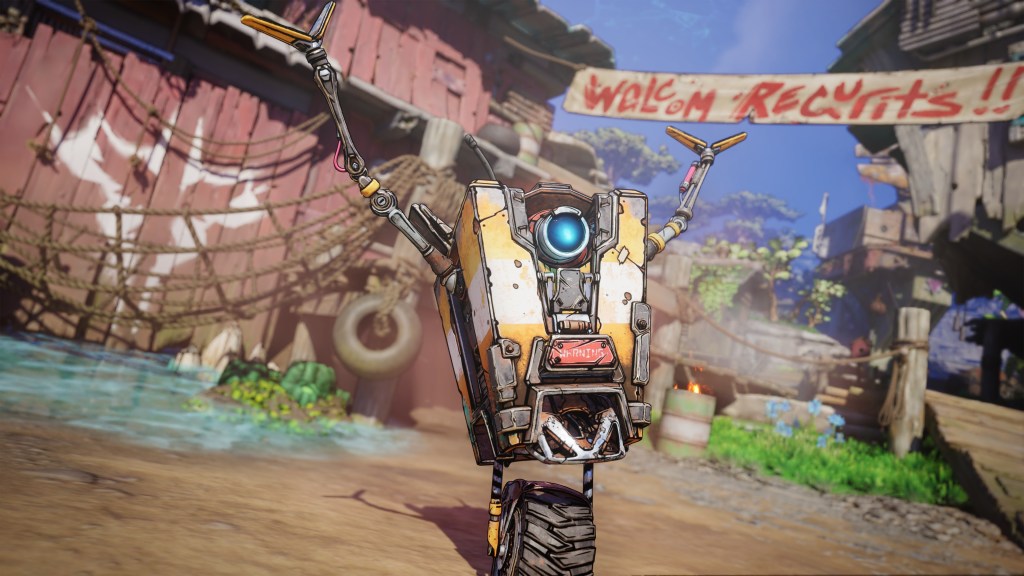
Yet Borderlands 4 contains a moment that lands with unexpected weight – a brief side mission that cuts through the series’ usual noise.
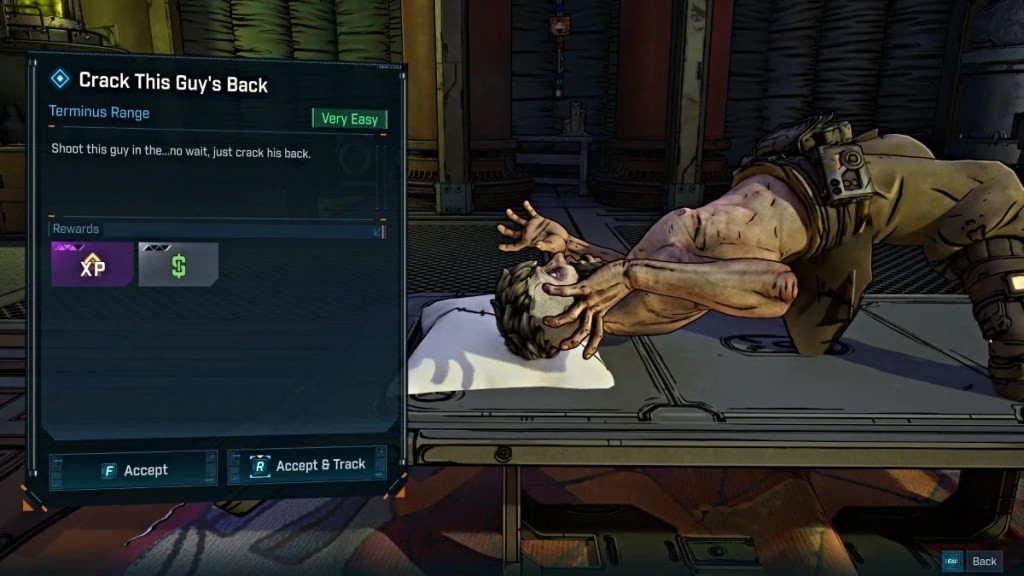
Crack Ma Backy is one of the many NPCs scattered across Kairos. He isn’t a war hero, a bandit, or a victim of the Timekeeper’s oppression. He simply wants relief from his back pain. The mission is framed as a throwaway joke, another absurd detour in a world defined by violence and suffering.
At first, the solution seems simple. One quick strike to the spine and Cracky straightens up in relief. Problem solved. Another inconvenience cleared on the road to saving Kairos.
Except the pain returns almost immediately.
Cracky begs for a second attempt, insisting this time that the treatment requires “setting the mood”. Candles are lit, a lotion dispenser repaired, and the ritual is performed – one that Cracky deems essential, despite its apparent futility. When that fails, he escalates the situation further, opening the skylight and asking the player to climb to the rooftops and hurl themselves downward to deliver the ultimate spinal adjustment.
Cracky screams in cathartic relief – and then fades from existence entirely, as if the pain was the only thing holding him together.
The sequence is played for laughs, but the punchline leaves behind a thought-provoking residue.
Lower back pain alone affects hundreds of millions of people globally, making it one of the leading causes of disability and lost work. Pain researchers and psychologists often describe pain not as a symptom, but as an experience – a concoction of sensation, memory, expectation, and emotion. Pain reshapes people’s identities, behaviours, and lives.
As pain researcher Lorimer Moseley puts it, pain is “not simply a direct response to injury, but an output of the brain, shaped by context, memory, expectation, and meaning”. Two people with identical injuries can experience completely different realities.
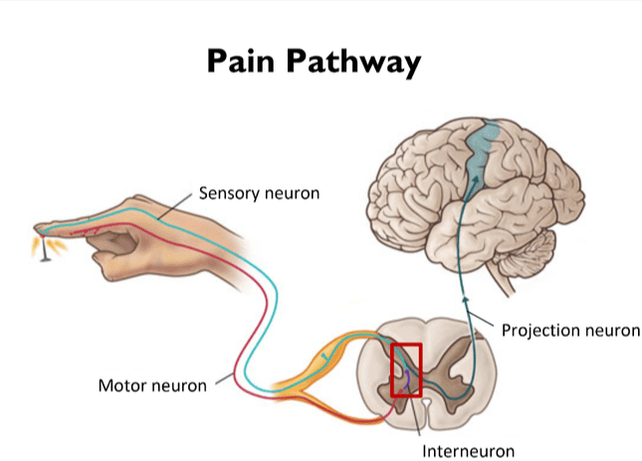
Pain is notoriously difficult to communicate. There is no simple description when individual experiences differ so wildly. This is where video games excel: they can simulate what it feels like to live with physical or psychological distress – how it escalates, ebbs, and flows – without requiring players to suffer directly.
Released in 2017, Hellblade: Senua’s Sacrifice follows the journey of Senua as she battles Norse gods to save the soul of her dead lover. More importantly, it provides a realistic depiction of psychosis through constant visual and auditory hallucinations.
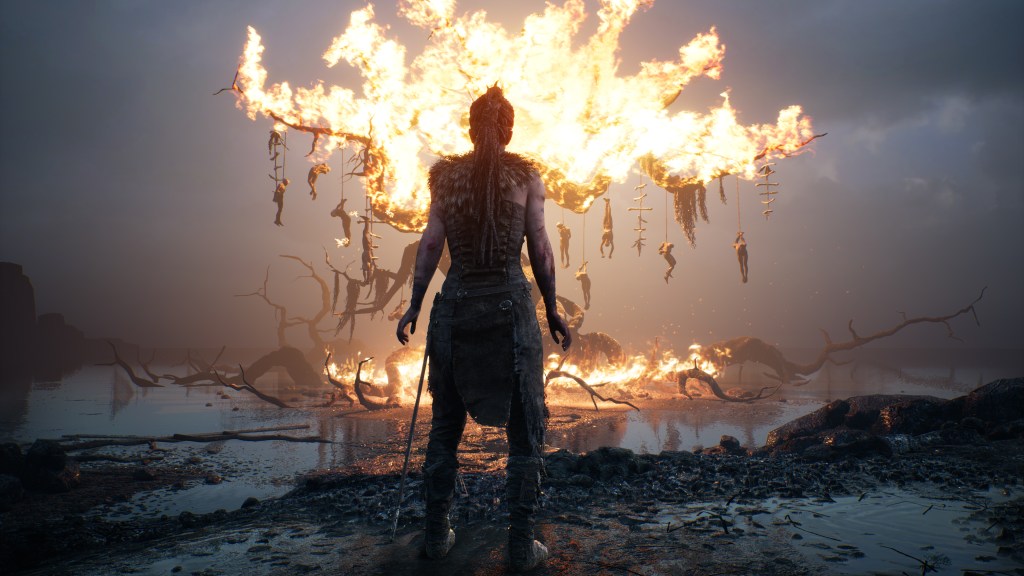
Ninja Theory’s creative director, Tameem Antoniades, has explained that the studio’s goal was never to explain psychosis, but to let players experience “a fragment of what it might feel like to live with it”. Through binaural 3D audio, the game recreates hearing voices not only as a narrative flourish, but as an invasive, inescapable presence.
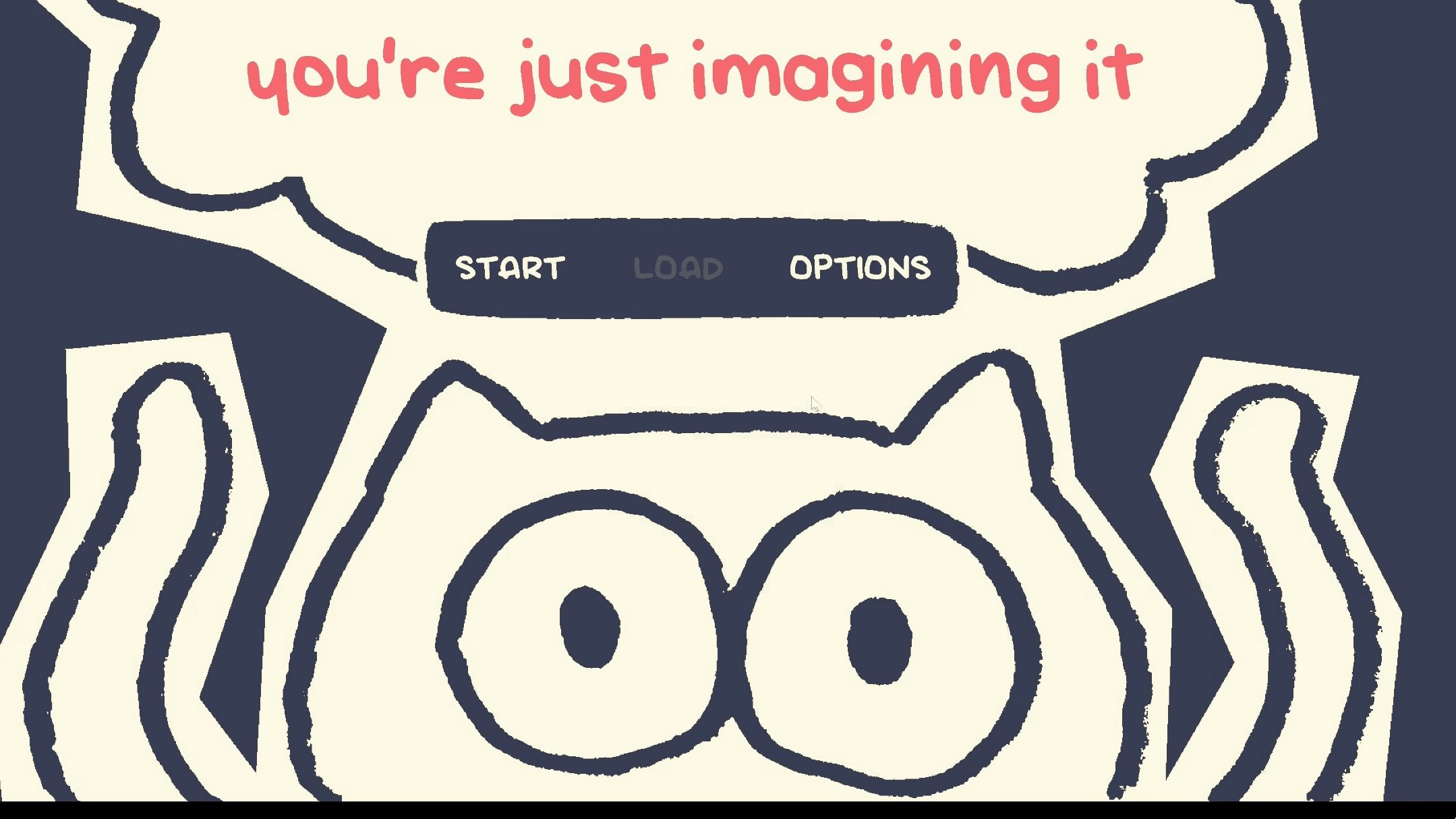
You’re Just Imagining It sets out to create a similar experience for chronic pain. Presented as a visual novel, it simulates the day-to-day reality of living with persistent pain. Instead of dramatising pain, it exposes the exhaustion of being medically dismissed, financially strained, and emotionally isolated.
Despite medical advances, consistent and reliable pain management strategies can be elusive. As a result, we live in a culture obsessed with immediate relief. Entire industries exist to manage pain – physiotherapy, osteopathy, chiropractic treatment, massage, pain psychology – and while many provide genuine benefits, the dominant expectation remains the same: immediate relief.
Comfort is prioritised over recovery; relief over long-term change. A satisfying crack, a heat pack, a painkiller, or an injection can all provide comfort, but it is often fleeting. In that light, Cracky’s desperation is familiar.
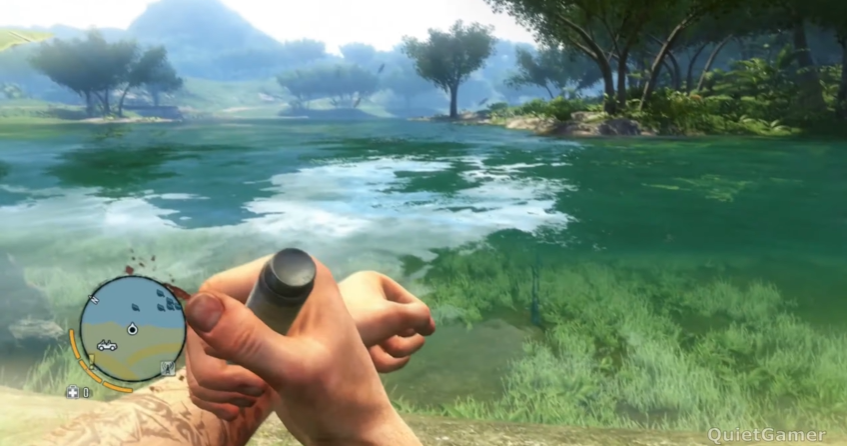
Games frequently reflect this mindset through their healing mechanics. Protagonists recover in ways that align with their worlds and identities. Geralt swigs potions, the Doom Slayer fuels his rampage through violence, and Far Cry revels in chaotic self-surgery. Bullets are yanked out, fingers snapped back into place, alcohol poured over wounds – healing becomes a spectacle. These animations are fast, visceral, and prioritise immediacy because that’s what people want: to get right back into the action.
So, what’s the point of the candles, the lotion, and the acrobatics?
Those living with chronic pain or illness mould their lives around it. Management becomes ritualised; pain relief often involves medication or external treatment, and recovery is rooted deeply in individuals’ psychology. The brain can release endorphins that genuinely reduce pain intensity – the placebo effect – but this depends heavily on expectation. Environment, belief, and routine all contribute to recovery, and even knowingly taking placebos can provide benefit if the context and belief are there.
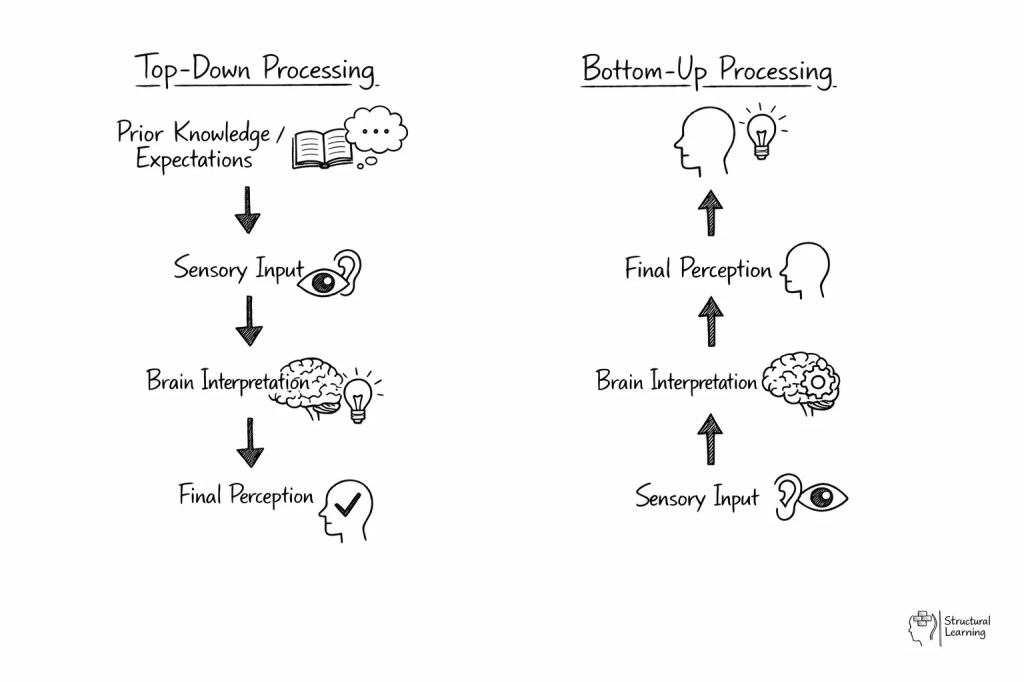
Psychologists call this “top-down modulation”: the mind’s ability to influence the body. Games communicate this intuitively. They teach players to trust healing through presentation, mechanics, and audio feedback. Players are conditioned to expect healing on certain cues – provided they can execute the action safely. The Estus Flask possesses a warm, iconic sound and animation that oozes familiarity. More recently, Hornet’s binding animation is predictable and weighty. Both provide players with a sense of comfort and relief – a fleeting moment of safety in otherwise hostile worlds.
As psychologist Judith Turner puts it, when people can’t control their pain, they often focus on “controlling the context around it”.
Cracky’s escalating ceremony fits neatly into this same framework. The candles and theatrics don’t address the underlying cause of his pain, but they restore a sense of control. Pain is chaotic – much like Pharloom or the Lands Between – and ritual makes it feel ordered. For chronic pain sufferers, these routines become the scaffolding that keeps them upright, and the pain begins to shape their identity.
But when management strategies become a staple of everyday life, finding relief can be destabilising. In that light, Cracky’s disappearance at the end of the mission isn’t a simple joke – it’s an exaggeration of something deeply human. When pain defines a person, its sudden absence can feel like losing a part of yourself.
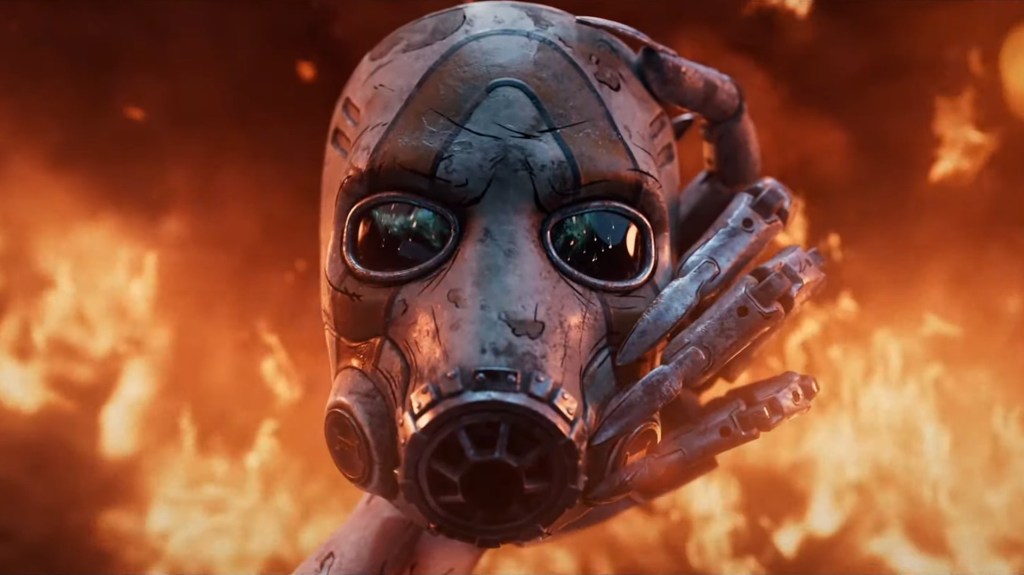
Borderlands 4 may not have set out to comment on the psychology of chronic illness the way Hellblade does, but through mechanics, escalation, and the game’s inherent absurdity, it communicates something vital. Pain is more than just a symptom; it’s something that shapes people’s lives and can become deeply intertwined with their personality.
Video games are one of the few ways people can experience what it’s like to live this way. Healing is more than just a button press – it’s a ritual: a familiar animation, a sound cue, a moment of reassurance that precedes relief. These systems are more than the restoration of a health bar.
And sometimes, games like these can help us understand pain – not by simply explaining it, but by letting us experience fragments of it safely, without putting ourselves in harm’s way.
Watch Video Essay Version on Youtube.
 Gaming Acuity
Leave a comment