

Amongst the wreckage and labyrinthine halls of a burning medieval city, there is a small metal drop pod housing a powerful weapon: the power gauntlet. A weapon that id Software has designed to display the unbridled power of the Doomslayer. At the click of a button, you can turn demons to nothing but blood and bone. For the entirety of Doom: The Dark Ages’ 14 hours of runtime, I spent every second beating demons to a pulp with my bare hands. Despite any shortcomings that the game has, it produces an immense feeling of power that I will be thinking about for a very long time.
Doom: The Dark Ages is a technical masterpiece. For the past decade, id Software has proven time and time again that they can create outstanding video games that perform right out of the box. No need for day-one patches, bug fixes, or long-winded apology JPEGs explaining how the game didn’t meet their normal high bar for quality. Just an excellent quality product. However, for every major leap forward, it feels like the game takes a substantial step backward. I found myself very conflicted while playing. On the one hand, the game is an adrenaline-fueled rollercoaster that barely lets up for a second, and on the other, it has an uninspired story, riddled with pacing issues and unnecessary gameplay implementations that detracted from my enjoyment of the game.
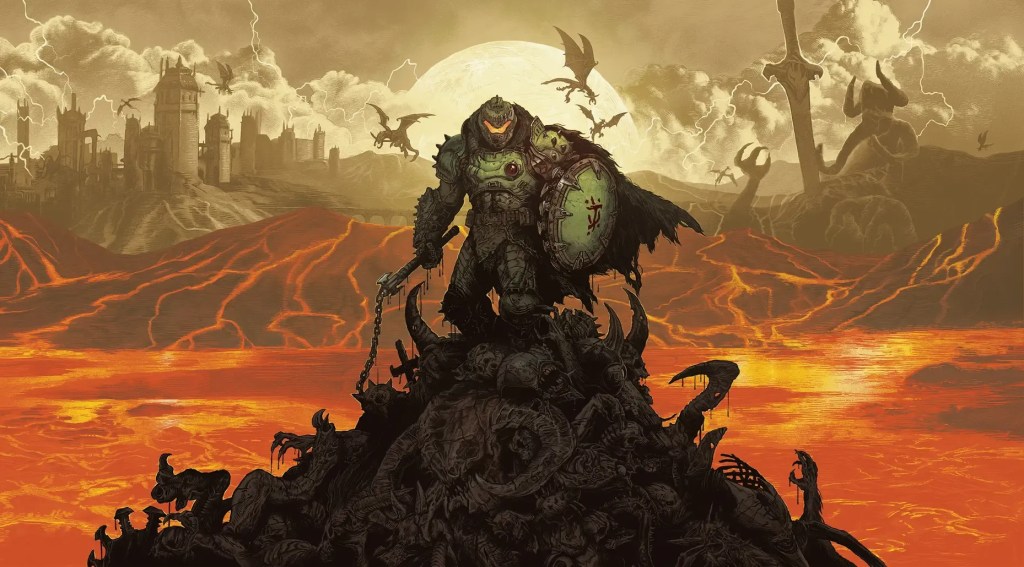
In The Shadow of Greatness
The Dark Ages is the prequel to Doom (2016), id Software’s unequivocal masterpiece. Like Doom Eternal before it, id Software has not settled for rehashing a tried and tested formula, and I admire this decision. Mass Effect 2 and Borderlands 2 were successful for expanding on their predecessors while developing small changes to improve the experience. Other games struggle to strike the balance between replication and progression, rendering the sequels dull and lifeless.
id Software’s approach to sequels is interesting. The push forward gameplay developed for the first game remains intact in Doom: The Dark Ages, but the foundational mechanics underpinning that system have changed dramatically. Doom (2016) emphasised fast movement and smooth combat, rewarding good positioning and smart target prioritisation. Eternal implemented a combat system that involved frequent weapon switching, as each enemy needed to be defeated by a specific armament. It featured combat puzzles instead of combat encounters. In The Dark Ages the emphasis is on hand-to-hand combat and parrying projectiles like a demonic ping pong player. The Doom Slayer is heavier and slower, but this adds weight and tactility to melee combat and weapon handling that was missing in Eternal. This is the ultimate Doom fantasy, getting up in a demons’ face and beating it to a pulp with your bare hands is blood pumping.
The returning and new weapons complement melee combat perfectly. The chain shot fires a ball and chain projectile that is recalled quickly after each shot. It is the perfect marriage of devastating weaponry and medieval aesthetic. A far more intimate form of destruction compared to something like a plasma rifle.
The skill trees available make game-altering changes to the weaponry rather than mere stat bumps. For example, one causes the next chain shot to instantly charge after a successful parry or, the same parry can turn a rockets splash damage into a healing aura keeping you up close and personal with the enemy for longer.
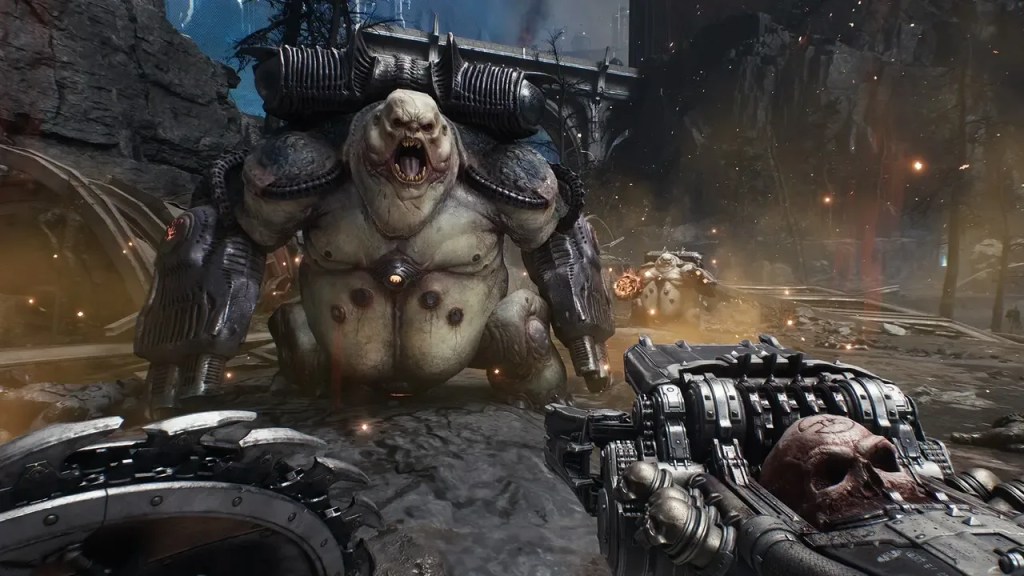
Talking of parrying – the Doomslayer’s shield is another new addition to the arsenal, acting as the players main form of defence and a powerful repositioning tool. Holding down block allows you to leap to a distant enemy instantaneously turning them into a pile of bones and viscera on impact. The range is incredibly generous so you can escape precarious positions in a pinch or charge further into battle to capitalise on combat momentum. This feels like a necessary change, given the removal of the aerial combat abilities of Doom: Eternal, and without it the entire game would feel sluggish and unwieldy. Given it is large departure from the universally praise controls of the previous game it is sure to be a contentious decision, with many people wishing they had stuck to the fast-flowing combat and rapid manoeuvrability of Eternal. While the movement here is slower, it feels far more deliberate, with each movement carrying substantial weight in part due to the excellent sound design. It is a design choice that I loved.
Unfortunately, that slowing down of the games pace translates very poorly when swapping weapons. Where Eternal necessitates weapons swaps to deal with enemies and keep ammo reserves topped up, now weapon swapping comes with a lengthy animation (particularly when coming out of a melee attack). This conjures two major problems. Running out of ammo mid encounter can feel like a death sentence, and it reduces the player freedom Doom fans have come to know and love. I compare it to animation locks in a 3D fighting or action games. Locking a player into an animation without the ability to cancel is a frustrating and often leads to games being overly punishing or frustrating to control. At best it’s annoying, but at worst, it usually results in death (especially on the higher difficulties). Once upgraded I ended up focussing on one or two main weapons, rarely switching outside of instances where my choice was not managing the encounter effectively. That focus on one weapon keeps the flow of combat fast paced and adrenaline-fueled but can become stale as the lengthy story ends.
Story
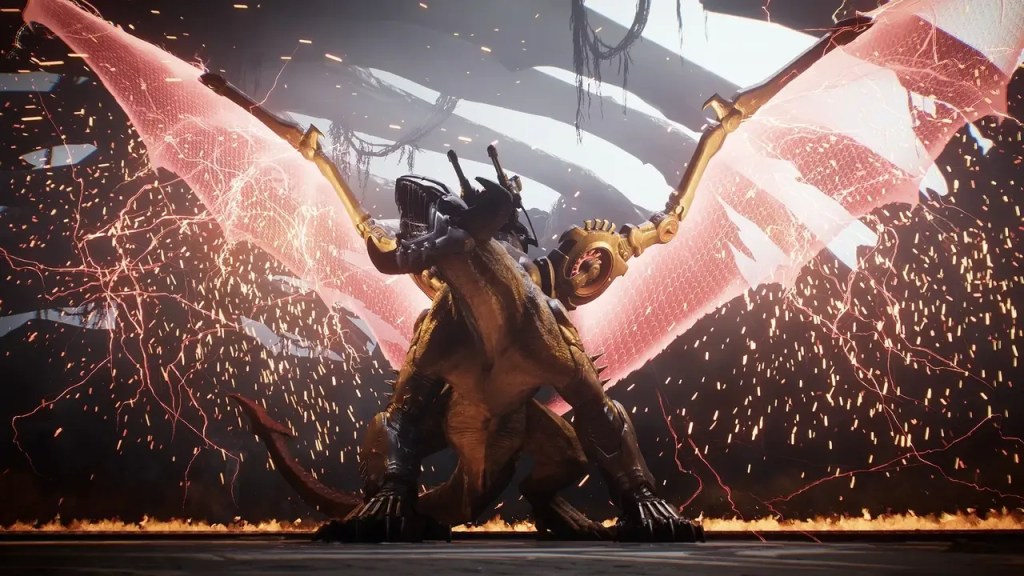
Doom games aren’t necessarily known for their pioneering stories, but this is one area where The Dark Ages takes a huge step backwards. The campaign runs about 22 missions, far longer than the lean offerings of 2016 and Eternal. It overstays its welcome. This wouldn’t be a problem if every mission met the same high standards, but there are standout moments in the campaign for all the wrong reasons. The dragon and mech missions are the biggest offenders. They feel inserted into the game for their admittedly incredible visuals, but they halt the campaigns pace and elicited an audible grown on their arrival. To top things off the controls for the Dragon are a crime. You can only deal with bigger targets when locked on and this limits movement to a directional dodge. Although the mech missions are slightly better, they are still a massive departure from the excellent gameplay of the rest of the game.
So, if the mech and dragon missions are poor from a gameplay and pacing perspective, the final mission is a violation of good story telling.
The penultimate mission is an adrenaline-fueled thrill ride, capped off with an exhilarating two part boss fight weaved around emotional story beats (avoiding spoilers of course), but after finishing the mission instead of coming to a satisfying conclusion the game whisks you into a long, arduous, and uninspired level. A level which concludes with another boss fight, on which is a significant step down in quality and spectacle from the penultimate mission. And when it finishes, the game ends abruptly.
When a games primary focus is making the player feel powerful it would do well to have the final encounter be a culmination of everything the player has learned up until that point, and a challenge worthy of that power and mastery. This final mission fell very flat and left a sour taste when rolling the credits. A feeling which could have been avoided if the mission had been removed completely.
Why Doom!
Irrespective of Doom: The Dark Ages’ shortcomings, I can’t overstate how much fun it is to play this game. Players will always compare it to its predecessors – noting that Doom (2016) was more streamlined, and Eternal had better movement and mechanical complexity – but no one can deny that Doom: The Dark Ages is a F***ing fun game. There are very few games that afford you this much power, to play the way you want, and charge through the battlefield like a barbarian tearing enemies’ limb from limb.
So, when one comes around, we should treasure it – and when a studio makes three of these games in a row, we would do well to celebrate it.
Doom: The Dark Ages is available on PS5, Steam, and on Xbox for purchase and through gamepass.
 Gaming Acuity
Leave a comment